
🧠 Introduction
As Large Language Models (LLMs) like GPT, Claude, and Gemini become central to AI applications, evaluating their performance is essential for ensuring reliability, safety, and optimal user experience. LLM evaluations go beyond accuracy—they test reasoning, context understanding, hallucination rates, and even bias.

📊 Why Evaluate LLMs?
LLMs are not deterministic programs. Their outputs can vary:
- Based on prompt phrasing.
- Temperature and sampling settings.
- Contextual history.
Evaluating them helps in:
- Measuring output quality.
- Detecting bias and toxicity.
- Benchmarking against competitors.
- Ensuring alignment with user and business goals.
⚙️ Types of Evaluation
1. 🧮 Automated Evaluations
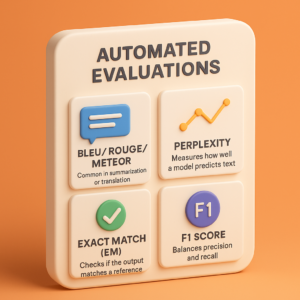
Automated evaluations use predefined metrics and algorithms to score a model’s output against ground truth or expected answers. These methods are fast, consistent, and cost-effective, especially when dealing with large datasets or iterative model development.
Let’s break down the most commonly used ones:
🔹 BLEU (Bilingual Evaluation Understudy)
- Used for: Machine translation, summarization
- What it does: Compares n-grams (phrases of n words) of the model’s output with a reference. The more overlapping n-grams, the higher the score.
- Scale: 0 to 1 (or 0 to 100). Higher is better.
- Limitation: Focuses only on surface-level similarity; doesn’t account for meaning or paraphrasing.
Example:
- Reference: “The cat sat on the mat.”
- Output: “The cat is on the mat.”
- BLEU Score → High, due to many matching words.
🔹 ROUGE (Recall-Oriented Understudy for Gisting Evaluation)
- Used for: Text summarization
- What it does: Measures the overlap of units like words, bigrams, or sequences between model output and reference.
- Types:
- ROUGE-N (n-gram overlap)
- ROUGE-L (longest common subsequence)
- Strength: Captures more recall (how much of the reference the model covered).
- Limitation: Still surface-level and ignores deeper semantic meaning.
Example:
- Reference: “Global warming is caused by pollution.”
- Output: “Pollution is a cause of global warming.”
- ROUGE will score this fairly high despite different word order.
🔹 METEOR (Metric for Evaluation of Translation with Explicit ORdering)
- Used for: Translation, summarization
- What it does: Improves on BLEU by accounting for:
- Synonyms
- Stemmed words (e.g., “running” vs. “run”)
- Word order
- Scale: 0 to 1 (higher is better)
- Strength: Better semantic matching than BLEU.
- Limitation: Still relies on string similarity, not true understanding.
🔹 Perplexity
- Used for: Language modeling
- What it does: Measures how surprised the model is by the correct output.
- Formula: Lower perplexity = better prediction = higher model confidence.
- Interpreting it:
- A low perplexity means the model is confident and accurate in its prediction.
- A high perplexity means the model struggled to predict the correct output.
Analogy: Perplexity is like the model’s “confusion level.” A confident model has low perplexity.
🔹 Exact Match (EM)
- Used for: Question answering, code generation
- What it does: Checks whether the model’s output exactly matches the reference answer (case- and punctuation-normalized).
- Limitation: Harsh—small variations or synonyms cause a 0 score.
Example:
- Reference: “New Delhi”
- Output: “Delhi” → EM Score = 0
- Output: “New Delhi” → EM Score = 1
🔹 F1 Score
- Used for: QA, extraction tasks
- What it does: Calculates harmonic mean of precision and recall:
- Precision: How much of the output is correct.
- Recall: How much of the correct answer is captured.
- Advantage: More flexible than EM, allows partial credit for partial matches.
Example:
- Reference: “Barack Obama”
- Output: “Obama”
- Precision = 1 (everything generated is correct)
- Recall = 0.5 (missed “Barack”)
- F1 Score = 0.66
🧠 When to Use Which?
| Metric | Best For | Example Task |
| BLEU | Translation, simple paraphrasing | Translate English to German |
| ROUGE | Summarization | Summarize news articles |
| METEOR | Translation + semantic matching | Multi-language QA |
| Perplexity | Pretraining, model diagnostics | Train LLMs from scratch |
| EM | Closed QA | SQuAD, trivia bots |
| F1 Score | Extraction tasks, partial match | Named entity extraction |
2. Human Evaluations
Used where quality is subjective.
- Fluency: Is the response grammatically correct?
- Coherence: Does the response make logical sense?
- Relevance: Does it actually answer the question?
- Factuality: Is it hallucinating?
🧠 Tip: Use Likert scale surveys, expert annotators, or crowd workers (e.g., MTurk).
3. Behavioral Testing
Check how the model reacts in specific edge cases.
- Adversarial prompting (jailbreaking attempts).
- Bias testing using controlled prompt sets.
- Consistency testing across different phrasing.
🔬 Performance Testing Techniques
🧪 Load & Latency Testing
- Measure how fast the model responds under load.
- Monitor GPU/CPU usage for optimization.
🧪 Stress Testing
- Push the model with extremely long prompts or rare edge-case data.
🧪 Regression Testing
- Ensures updates don’t break previously good behaviors.
📚 Common Benchmarks
| Benchmark | Purpose | Example LLMs |
| MMLU | Multitask reasoning | GPT-4, Claude |
| BIG-bench | General capability | PaLM, Gemini |
| TruthfulQA | Factuality | GPT-3.5, GPT-4 |
| Hellaswag | Commonsense reasoning | T5, LLaMA |
| MT-Bench | Chat model evaluation | ChatGPT, Claude, Mistral |
🧰 Tools for LLM Evaluation
- OpenAI Evals – Framework for testing OpenAI models.
- TruLens – Monitor and evaluate LLMs with explainability.
- LangChain + LangSmith – Logging, traces, and evaluation.
- LlamaIndex Eval – RAG and QA pipeline evaluation.
- Promptfoo – A/B testing LLM prompts.
- Weights & Biases (W&B) – Log LLM experiments & performance.
🧩 Real-World Use Case: E-Commerce Chatbot
Goal: Ensure chatbot answers queries accurately and empathetically.
Tests Run:
- Factuality: Does it pull correct data?
- Latency: How fast does it reply during sales spikes?
- Behavior: Does it deflect malicious prompts?
- Human evaluation: Does it sound helpful and polite?
🚀 Best Practices
- Start with clear goals: Is it for factuality, helpfulness, safety?
- Automate first, human-check later.
- Benchmark regularly – LLMs change frequently.
- Test real user scenarios.
- Log everything – for reproducibility and debugging.
🔮 Future of LLM Evaluation
- Simulated Users (AI agents to test AI agents)
- Zero-shot & few-shot evals on unseen domains
- Explainability-first metrics to catch hallucinations
- Bias & fairness dashboards for compliance
✍️ Conclusion
LLM evaluation isn’t just a technical chore—it’s a core process to build trustworthy, safe, and high-performing AI systems. Whether you’re building an AI writing assistant, search engine, or chatbot, continuous evaluation keeps your LLM aligned and impactful.