
You may wonder what is generative AI or gen AI. So lets see it in deep first we will start with standard definition
Definition : Generative AI (GenAI) is a type of artificial intelligence technology that can produce various types of content, including text, imagery, audio and synthetic data.
For better understanding let’s see where generative Ai lies.
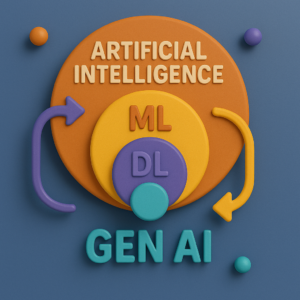
So broadly its comes under the deep learning.
Generally there are two types of models in machine learning discriminative and generative.
What Are Discriminative Models?
The discriminative model refers to a class of models used in Statistical Classification, mainly used for supervised machine learning. Discriminative models focus on modeling the decision boundary between classes in a classification problem.
Examples of Discriminative Models
- Logistic regression
- Support vector machines(SVMs)
- Traditional neural networks
- Nearest neighbor
What Are Generative Models?
What Are Generative Models?
Generative models are machine learning models that learn to generate new data samples similar to the training data they were trained on. They capture the underlying distribution of the data and can produce novel instances. Generative models find applications in image synthesis, data augmentation, and generating realistic content like images, music, and text.
Generative models are considered a class of statistical models that can generate new data instances. These models are used in unsupervised machine learning
Examples of Generative Models
- Naïve Bayes
- Bayesian networks
- Markov random fields
- Hidden Markov Models (HMMs)
- Latent Dirichlet Allocation (LDA)
- Generative Adversarial Networks (GANs)
In simple terms the output format of Gen AI is in following forms:
Natural Language
Image
Audio
Here are 10 practical applications of generative AI:
1. Content Creation
- Use Case: Writing articles, blogs, marketing copy, or social media posts.
- Example: AI-powered tools like ChatGPT or Jasper create text based on prompts.
2. Image Generation and Editing
- Use Case: Creating images, enhancing photos, and generating artwork.
- Example: Tools like DALL·E and MidJourney generate visuals from textual descriptions.
3. Video and Audio Production
- Use Case: Generating videos, dubbing, voiceovers, or music compositions.
- Example: AI can create deepfake videos, synthesize voiceovers, or produce original music tracks (e.g., AIVA for music generation).
4. Code Generation
- Use Case: Assisting developers by generating, debugging, and optimizing code.
- Example: GitHub Copilot suggests code snippets and automates repetitive tasks.
5. Healthcare and Drug Discovery
- Use Case: Generating molecular structures for drug discovery, medical imaging enhancements, or predictive diagnostics.
- Example: Generative AI models like AlphaFold predict protein structures for medical research.
6. Game Design and Virtual Worlds
- Use Case: Creating game assets, character designs, environments, and interactive storytelling.
- Example: Procedural generation of game levels or AI-generated NPC dialogues.
7. Chatbots and Virtual Assistants
- Use Case: Providing human-like responses in customer service, education, or personal assistants.
- Example: AI systems like Google Bard and OpenAI ChatGPT assist in conversations and FAQs.
8. Marketing and Personalization
- Use Case: Generating personalized ads, email campaigns, and product recommendations.
- Example: AI tailors marketing content to user preferences using data insights.
9. Fashion and Design
- Use Case: Designing clothes, creating virtual try-ons, or suggesting outfit combinations.
- Example: AI tools generate unique apparel designs or virtual fitting rooms.
10. Education and Training
- Use Case: Creating personalized study materials, quizzes, and interactive learning experiences.
- Example: AI can generate exercises tailored to a student’s proficiency or even create entire courses.